Aerospace-grade engineering
The same stack used to design airplane wings, turbine blades and F1 fairings. Applied to surf fins.

Simulation
CFD with OpenFOAM 13
Steady-state incompressible RANS simulation with simpleFoam solver and low-Reynolds k-? SST turbulence model (Menter 1994). Fluid: real seawater with ?=1.0·10?6 m²/s and ?=1025 kg/m³ at 7.5 m/s (˜27 km/h).
-
snappyHexMesh meshLevel 5 surface refinement + 5 prismatic layers (ratio 1.3). Coarse: ~706k cells. Fine: ~2–3M cells. Real physical boundary conditions.
-
Precision numericsPressure: GAMG (tol 1e-7). Velocity/turbulence: smoothSolver (tol 1e-8). Divergence: Gauss linearUpwind. Relaxation: p=0.3, U/k/?=0.7.
-
4 angles of attack5°, 10°, 15°, 20° in virtual tunnel conditions. Complete Lift/Drag curves for each geometry. 93,619 total iterations in 78.6 h-CPU.
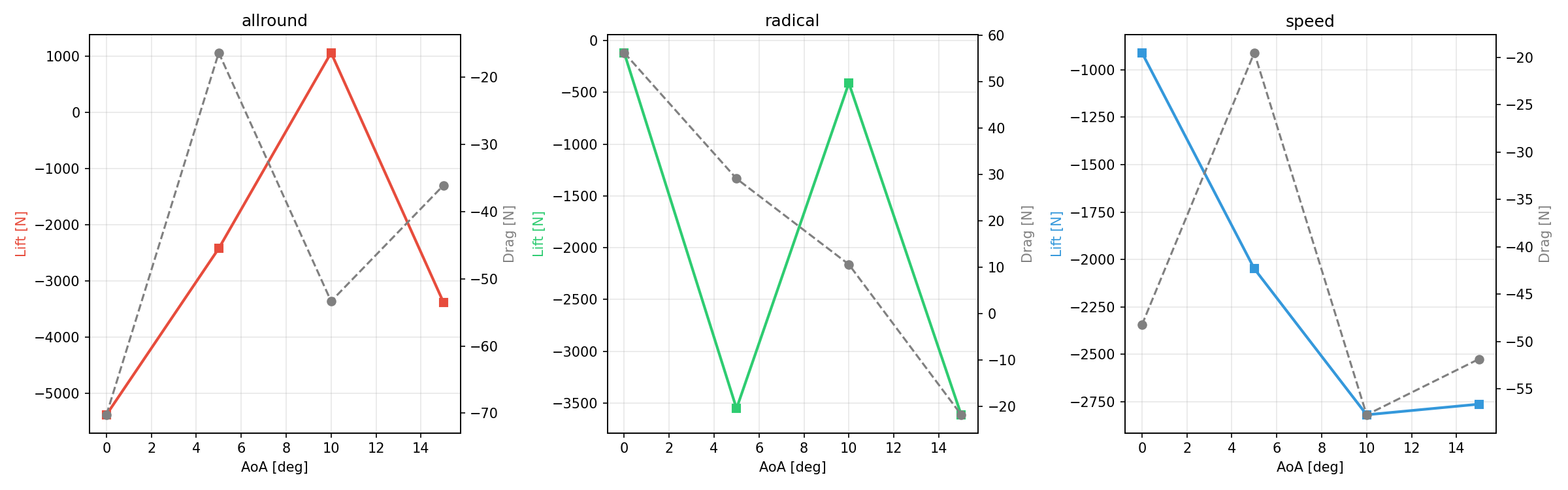 CFD Validated
 NSGA-II
Optimization
Multi-Objective Genetic Algorithm
NSGA-II (Non-dominated Sorting Genetic Algorithm II) explores thousands of parametric geometries to find the optimal Pareto front. Each candidate is evaluated with full CFD, not with cheap surrogate models.
-
Real optimization over 3 objectivesMaximize lift, minimize drag and maximize stall angle. With real manufacturing constraints: minimum thickness, overhang, material volume.
-
Massive design space explorationHundreds of geometries evaluated with CFD. This is not manual parametric design — it's automated mathematical optimum search.
-
NACA parameters + biomimeticsThe algorithm optimizes sweep, rake, twist, cant angle, thickness and chord. Plus biomimetic feature parameters: tubercle amplitude and frequency, serrations and microchannels.
Manufacturing
High-Performance 3D Printing
Geometries impossible to manufacture with traditional molds: leading edges with tubercles, trailing edges with serrations, surfaces with microchannels. Additive manufacturing frees design from mold constraints.
-
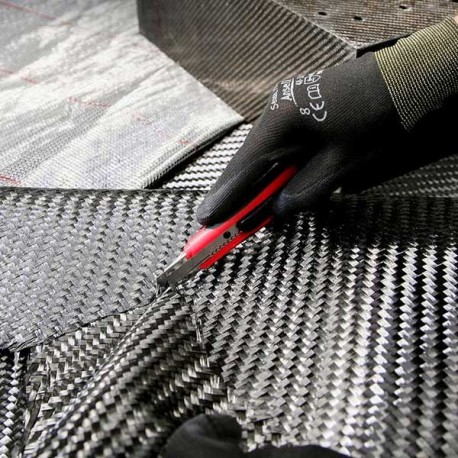
PA-CF: carbon-fiber nylonEngineering-grade material with superior stiffness and strength. Epoxy coating for hydrodynamic finish. Structural reinforcement with 3K Twill carbon weave.
-
Complex geometries at no extra costTubercles, serrations, channels, smooth transitions — everything printed in a single piece. No molds, no joints, no design compromises.
-
Standard FCS II systemUniversal box compatible with all boards on the market. NACA fillet with 3 mm radius for smooth blade-to-box transition. Ready to install.
 Additive Manufacturing
 Biomimetics
Biomimetics
3 natural patterns. CFD-validated.
It's not decoration. Each biomimetic feature is parameterized, simulated and optimized. Nature solved these hydrodynamics problems millions of years ago.
-
Leading-edge tuberclesInspired by Megaptera novaeangliae flippers. Delay stall, improve control at high angles of attack. RADICAL: 4 mm × 5 cycles. ALLROUND: 1.5 mm × 3 cycles.
-
Trailing-edge serrationsInspired by Bubo virginianus feathers. Reduce hydrodynamic noise and improve efficiency. RADICAL: 6 mm × 6 cycles.
-
Surface microchannelsInspired by Carcharodon carcharias dermal denticles. Reduce skin friction. RADICAL: 0.5 mm × 8 channels.
Pipeline
100% automated development cycle
The entire pipeline is implemented in Python as open-source software (LGPL-3.0). Parametric design, CFD, optimization and manufacturing integrated in a single workflow.
Parametric design
NACA profiles with sweep, rake, twist, cant angle, thickness and chord controlled by algorithm. Biomimetic features applied parametrically. Software: Python + Gmsh.
snappyHexMesh meshing
Structured mesh with edge refinement and prismatic layers. Boundary conditions: no-slip on fin, slip on tunnel walls. ~3M cells per fine case.
CFD simulation
RANS k-? SST with simpleFoam in OpenFOAM 13. 4 angles of attack. Real seawater. 93,619 total iterations in 78.6 h-CPU.
NSGA-II optimization
Multi-objective genetic algorithm. Each candidate evaluated with CFD. Convergence to Pareto front in ~50 generations.
STL export + Manufacturing
High-resolution STL mesh (~61k triangles). PA-CF with epoxy coating. 3K Twill reinforcement. FCS II system.